
So you “implemented AI” but you’re not seeing actual return?
You hired consultants. They conducted an assessment. They interviewed your team.
They got paid.
But you can’t explain what the ROI is, if there even is any.
Study after study echoes what you’re seeing: the way most companies roll out AI solutions is just not working.
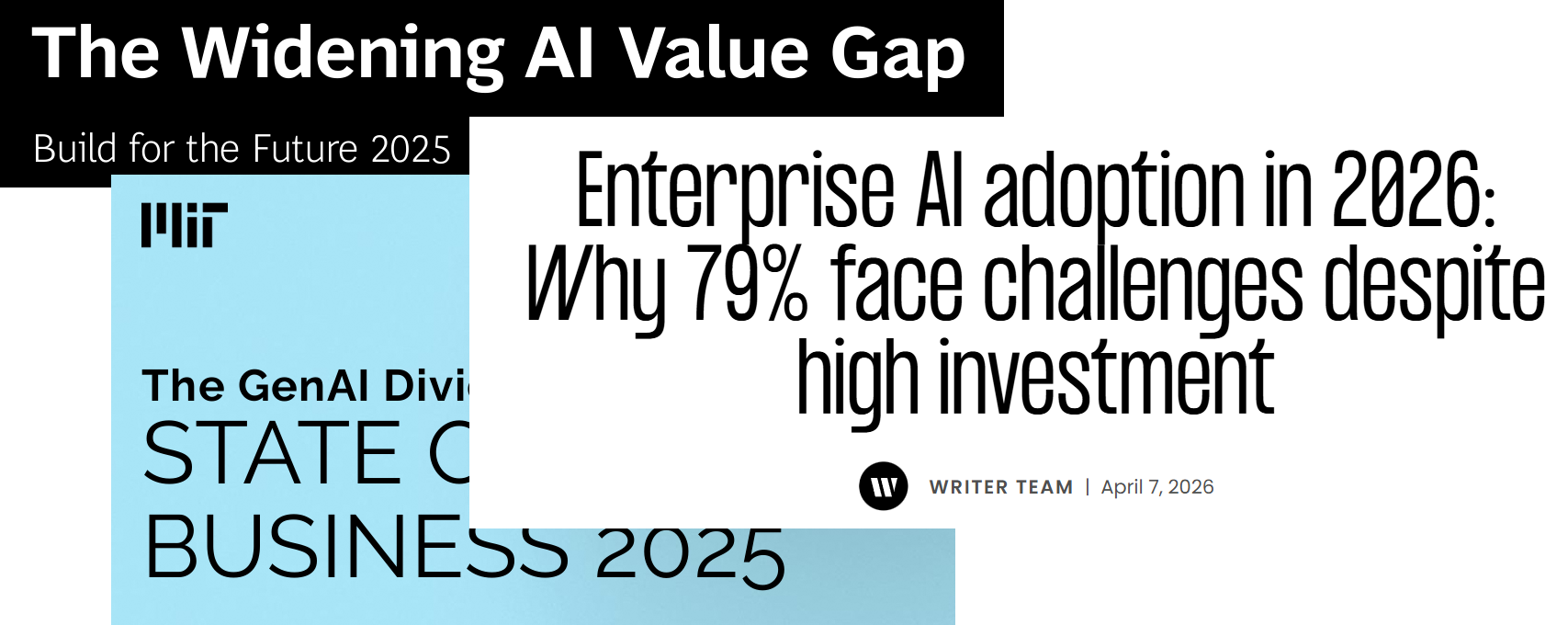
WRITER found this spring that only 29% of companies adopting AI are getting significant ROI from adopting AI. Worse, last year both BCG and MIT NANDA reported that 95% of companies piloting AI saw no measurable ROI.
Most leaders think that implementing AI is like waving a magic wand. They tell their team “use AI” but with no explanation of why, or how, or for what. They don’t do real training on the tools, they don’t explain what “use AI” means, and they don’t assure anyone that they’re not training AI to replace them.
It’s no wonder they’re getting nowhere!
I hate to break it to all those leaders, but there’s no AI magic wand.
But there is a way to get real value from using AI. Value that means each person is more productive for the business, and isn’t afraid they’re about to get laid off.
It starts with designing your AI usage to solve real problems. Real problems that can be described, measured, and solved.
Problems like:
• Getting interrupted constantly to answer the same questions over and over again
• Understanding what customers really think about your offerings from the pile of customer service tickets your support team gets every day
• Tracking key metrics so your team so your team can spend less time pulling together the data and more time planning for the next launch.
Either way, the only way to get value from AI is to truly understand the problems your organization is facing. Then design specific solutions to solve those problems, on at a time.
It’s not glamorous. There’s no magic wand, no quick solution. It’s slow, it’s tedious, and it’s so worth it!
Because when you put in the effort, that’s when the ROI follows.
The team is bought into it because it makes their day easier. Their minds are freed up to do the deep thinking that leads to real impact. You get credit for “implementing AI” that actually made a difference.
And the elusive promise of “do more with less” is finally possible.
I’ve spent more than 25 years in big tech solving real customer problems and driving change at an enterprise level. Now I do that for businesses of all sizes. If you want to learn how to take a quantum leap with AI, you’re in the right place.
Let’s find time to connect and talk about how your organization can become one of the few who do AI right.
AI Idea of the Week
The other day someone asked me to follow up with them after the new year. If you had to do that, and your reliability could mean the difference between making a sale and losing credibility, how confident are you that you could follow through?
I’m 100% confident I’ll remember. My AI Chief of Staff will make sure of it.
I get a daily message from my AI Chief of Staff (I named her Eva, after the sleek robot in Wall-E) telling me who I need to follow up each day. So for that person who asked me to follow up, I marked the date I want a reminder, and I’m positive I’ll be reminded on the day.
The thing about AI is: it’s reliable when you know how to ask for things. Yes, AI hallucinates sometimes (or makes things up, if we’re being blunt). But in many (most?) cases it’s possible to avoid that by prompting carefully. In this case, I gave Eva a specific date. She already knows to send a daily note. There’s no room for interpretation on my instructions, so I trust that I’ll get the reminder when I need it.
Which means I was completely confident telling this person that I will absolutely reach out to them in January. In the meantime, my mind is free to think about other things.